


Acrylic Quality Control Process
Custom acrylic products undergo a complete 4-stage inspection: incoming material inspection, production process inspection, final product inspection, and pre-shipment verification. We establish clear inspection points and standardized criteria, and implement a robust system for reworking unqualified products.
Incoming Material Inspection
- Sheet flatness, no impurities, bubbles, or ink streaks.
- Measurement of sheet thickness using a digital caliper (±0.1mm tolerance).
- Surface inspection for scratches, dents, or protective film damage.
- Color verification of each sheet (especially for colored/mirrored sheets).
Defective sheet materials are immediately returned to the supplier. We refuse to process unqualified materials to avoid wasting processing time and to ensure the final product perfectly matches your drawing.
In-Process Inspection
- Dimensions and fit verified against production drawings (±0.3mm tolerance).
- Polished edges checked for smoothness, absence of cuts, and straight or curved accuracy.
- Evaluating the aesthetics of the surface print.
- Cross-checking and confirming the alignment before completing the process.
If an issue is found here, production stops immediately to prevent the defective item from continuing to the next stage. Any imperfect pieces are immediately re-cut to ensure no defective products pass through.
Final Product Inspection
- Comparing the sample for matched appearance — checking every piece, not just sampling.
- Checking all finished printed items, looking for typos, logo matching, or overlapping patterns.
- Testing assembly integrity — checking hinge strength, hardware fitting, and overall structure.
- Verifying color consistency and print position for UV printing.
Every item that does not perfectly match the approved sample is rejected. There are no exceptions or "minor issues." Any defective piece is pulled from the batch and reworked from the beginning.
Pre-Shipment Inspection
- Packaging boxes are inspected for proper packing and protection for transit.
- Packing integrity confirmed — EPE foam, poly bags, and protective layers secured.
- Purchase order quantities verified for accurate counting.
- Shipping labels, documentation, and packing lists are double-checked and verified.
If an issue is found during packing, the entire batch is immediately repacked and re-verified. Goods will not leave the factory until the final check is completed.
Acrylic Waste Recycling
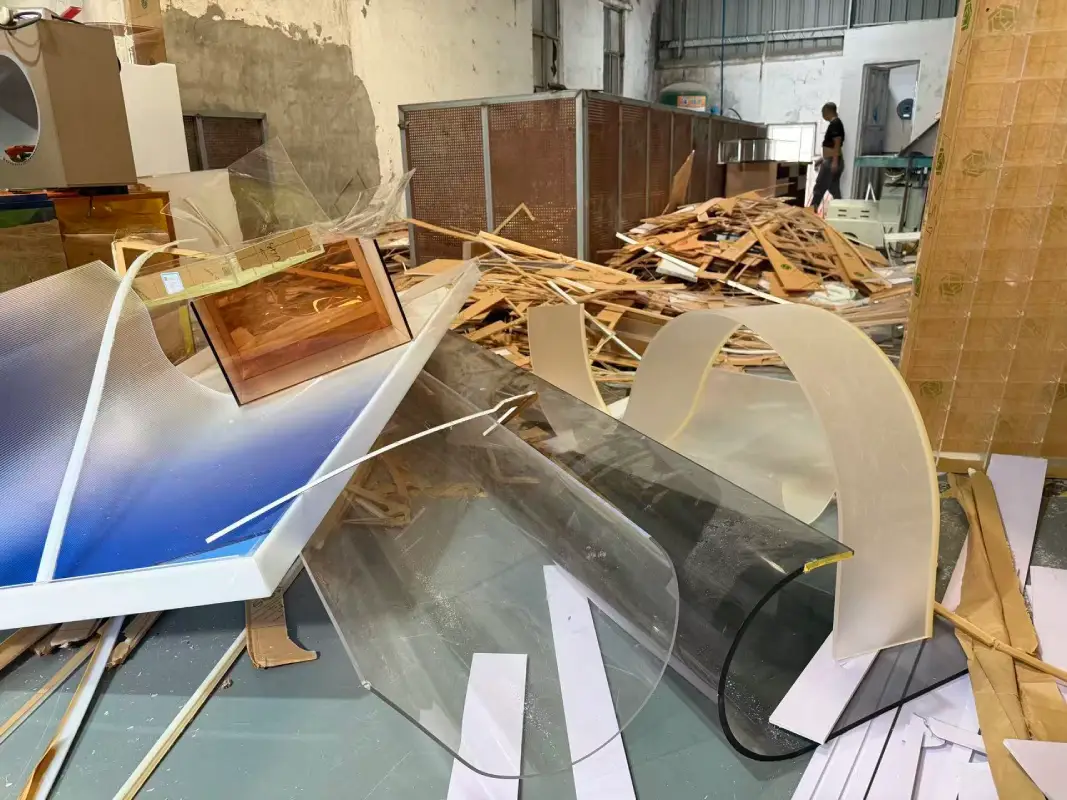
Our acrylic manufacturing process generates edge scraps, cutting offcuts, and unqualified products. We refuse to utilize secondary processing materials. We have established a strict waste classification and treatment system. Recyclable acrylic waste is collected and sent to material recycling plants to promote resource circulation. Non-recyclable waste is processed in accordance with environmental protection standards, reducing environmental burden and adhering to a green production philosophy.
Certifications & Their Implications
Understanding the actual scope of certification coverage enables you to accurately assess its value and understand its practical impact on your specific order.
REACH is the EU chemical regulatory framework. It certifies that our acrylic materials do not contain SVHCs (Substances of Very High Concern), meeting EU chemical compliance requirements. We do not rely on self-declarations; all tests are conducted and verified by third-party laboratories.
Scope of Coverage:
- SVHC screening and analysis.
- Chemical composition verification.
- Consumer contact safety compliance.
- EU market export compliance.
California Proposition 65 is a US consumer product safety regulation. It certifies that our products do not release harmful substances that can cause cancer, reproductive toxicity, or birth defects, mitigating product liability risks and meeting requirements for the California and broader North American markets.
Scope of Coverage:
- Cancer and reproductive toxicity screening.
- Daily exposure risk assessment.
- Consumer product compliance.
- Compliance with California market legal risks.
TSCA is the US federal toxic substances control act. It certifies that our raw materials comply with EPA requirements, containing no PBT (Persistent, Bioaccumulative, and Toxic) substances. This ensures smooth US customs clearance and meets stringent compliance standards for large US retail chains.
Scope of Coverage:
- PBT persistent bioaccumulative toxicity screening.
- Chemical component compliance verification.
- US federal chemical substance import compliance.
- US customs clearance compliance.
What Happens If a Product Issue Occurs?
The vast majority of issues are intercepted during the factory inspection stage. However, if a defective product reaches you, here is our clear, actionable, and standardized process. We offer no empty promises—everything is executed to standard.
Submit Feedback
Within 7 days of receipt, please provide photos of the defective product. Simply send an email with the order number and the images attached. There's no need to fill out complex forms or submit tickets; replying to the email with images is sufficient.
Response & Verification within 24 Hours
Our QC team will compare the photos with your approved samples and our full inspection records to determine if the defect occurred during manufacturing. We do not rely on textual definitions; if the product does not meet the standards you approved, we take full responsibility.
Free Reproduction and Shipment
Once confirmed as our manufacturing defect, we will strictly reproduce the parts according to the original approved samples. All production and logistics costs for the replacement are fully borne by us. Typical turnaround time: 10-15 days after issue confirmation.
Root Cause Analysis & Continuous Improvement
Every defect feedback triggers an internal Root Cause Analysis (RCA). We locate the specific production process where the issue occurred, update our QC checklists, and optimize production workflows. This prevents the same issue from recurring on the same product.
Every Product Undergoes 100% Full Inspection with Strict Quality Control
Every finished item is meticulously inspected against your approved samples before shipment.
All custom acrylic orders from our factory undergo a rigorous four-stage quality control process, from raw material inspection to pre-shipment verification. Since 2012, we have completed over 2,000 projects with a stable defect rate below 0.5%, ensuring every delivery perfectly matches your confirmed samples.
Frequently Asked Questions
What is the tolerance range? What is considered a normal occurrence within allowed limits?
The standard tolerance for acrylic CNC machining is ±0.1-0.3mm. Subtle ripples on the sheet, extremely fine material air bubbles, or slight color differences between different production batches are inherent material properties within industry standards and are not considered manufacturing defects. However, dimension deviations, edge chipping, surface scratches, printing misalignment, or assembly misalignment are classified as production defects.
When quality issues occur, do you only send replacements, or do you also improve the production process?
Every piece of defect feedback triggers an internal Root Cause Analysis (RCA). We identify the exact production process where the error occurred, update our quality control checklists, and adjust the production workflow. This systematic approach ensures the same type of quality issue will not recur on similar products in future orders.
What is your approximate defect rate?
Our target defect rate is 0.5%, which means roughly 5 units per 1000 may have minor imperfections. The vast majority of defects are intercepted early during our factory's four-stage quality inspection process and will never be shipped to our clients. Our strict quality control ensures you receive flawless products.
Can you arrange third-party inspection (on-site factory audit / pre-shipment inspection)?
Yes, we support third-party inspections. You can arrange for an external inspection agency to visit our factory during the mid-production stage or before shipment. Please notify us in advance of the inspection time, and we will gladly arrange access and provide all necessary quality documentation.